
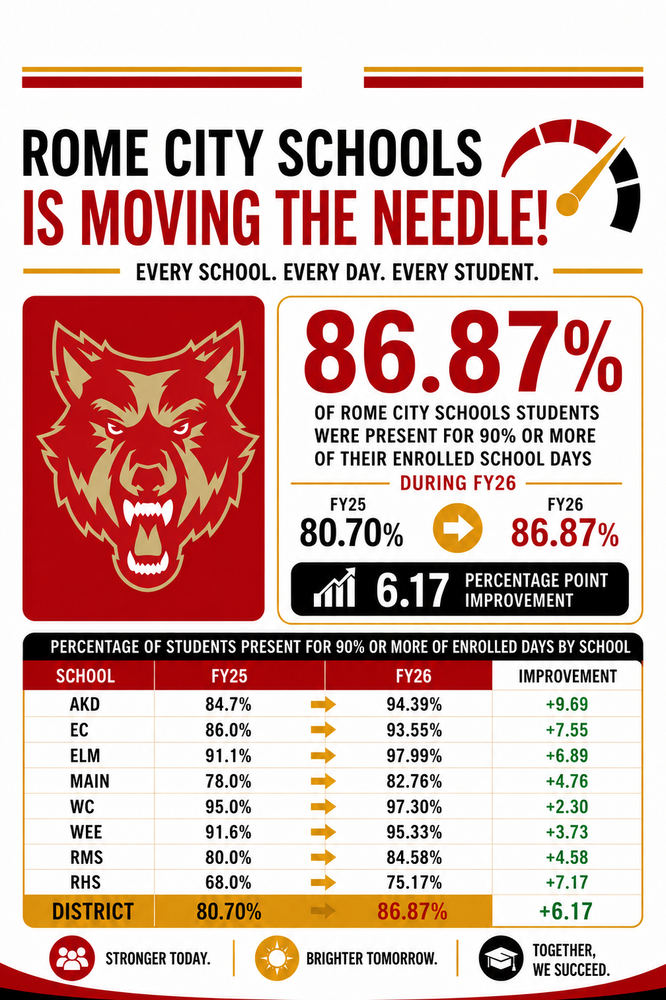
Rome City Schools continues to move the needle when it comes to student attendance, with every school in the district reducing its Chronic Absenteeism Rate (CAR) during the 2025-2026 school year.
The district's overall chronic absenteeism rate dropped from 19.30 percent during the 2024-2025 school year to 13.13 percent in 2025-2026, representing a districtwide improvement of 6.17 percentage points.
Chronic absenteeism measures the percentage of students who miss 10 percent or more of the school year for any reason, including excused and unexcused absences. Under Georgia law, a student is considered chronically absent after missing approximately 18 days if enrolled for a full 180-day school year.
Superintendent Dr. Eric L. Holland said the improvement reflects a districtwide commitment to ensuring students are in school and engaged in learning every day.
"Student attendance is directly connected to student success," Holland said. "When students are in school consistently, they have more opportunities to build relationships with teachers, stay on track academically, participate in extracurricular activities, and prepare for their future. We are proud of the progress our schools have made, but we know there is still more work to do."
Every Rome City School either met or exceeded the district's goal of reducing chronic absenteeism, with several schools posting substantial gains.
Anna K. Davie Elementary School reduced its chronic absenteeism by 9.69 percentage points. East Central Elementary improved from 14 percent to 6.45 percent, while Elm Street Elementary saw its rate fall from 8.9 percent to just 2.01 percent.
Rome High School reduced chronic absenteeism from 32 percent to 24.83 percent, a decrease of 7.17 percentage points. Rome Middle School improved from 20 percent to 15.42 percent, while Main Elementary, West Central Elementary, and West End Elementary also recorded significant improvements.
District leaders said the gains are the result of a coordinated effort involving school administrators, teachers, counselors, social workers, attendance teams, students, and families. Schools have focused on building positive relationships with students, closely monitoring attendance data, communicating regularly with families, and removing barriers that may prevent students from attending school consistently.
Research consistently shows that students who attend school regularly are more likely to read proficiently by third grade, succeed in middle and high school, graduate on time, and be prepared for college or work.
The improvement also supports Rome City Schools' broader strategic focus on academic achievement and school climate. Attendance is a key factor in school accountability measures and plays an important role in helping schools improve student outcomes.
"Our schools are proving that when we work together, we can make a difference," Holland said. "These results show what is possible when students, families, teachers, and staff all share the same goal. We are stronger today because of the work that has been done, and we are building a brighter tomorrow for every student we serve."
While district leaders are encouraged by the progress, they emphasized that attendance remains a priority for the coming school year. Rome City Schools will continue working with families and community partners to ensure students are present, engaged, and ready to learn.
The district's 2025-2026 chronic absenteeism rate of 13.13 percent marks one of the strongest attendance improvements in recent years and reflects Rome City Schools' continued commitment to helping every student succeed through its Move the Needle initiative.